
Can Shareholders Challenge a Company's Chairman Appointment in Court?
Written by Aditi
At a glance
- AAuthorAditi
- Read Time5 min read
Introduction
Can a company's biggest shareholder go to court because it believes its chairman was appointed in breach of the rules? That is the question at the centre of a boardroom battle at Tata Sons. Two Tata trusts, which together hold about 66% of the holding company of India's largest conglomerate, have sued to challenge the reappointment of N Chandrasekaran as executive chairman. The case turns on how the company's Articles of Association work and on one disputed casting vote.
The Background
Chandrasekaran told the Tata Sons board on 12 August 2026 that he would not seek reappointment when his term ends on 20 February 2027. At the board meeting on 17 September, he said he had reconsidered and was willing to serve another five years, from 21 February 2027 to 20 February 2032. He recused himself as an interested director, and Harish Manwani chaired that agenda item.
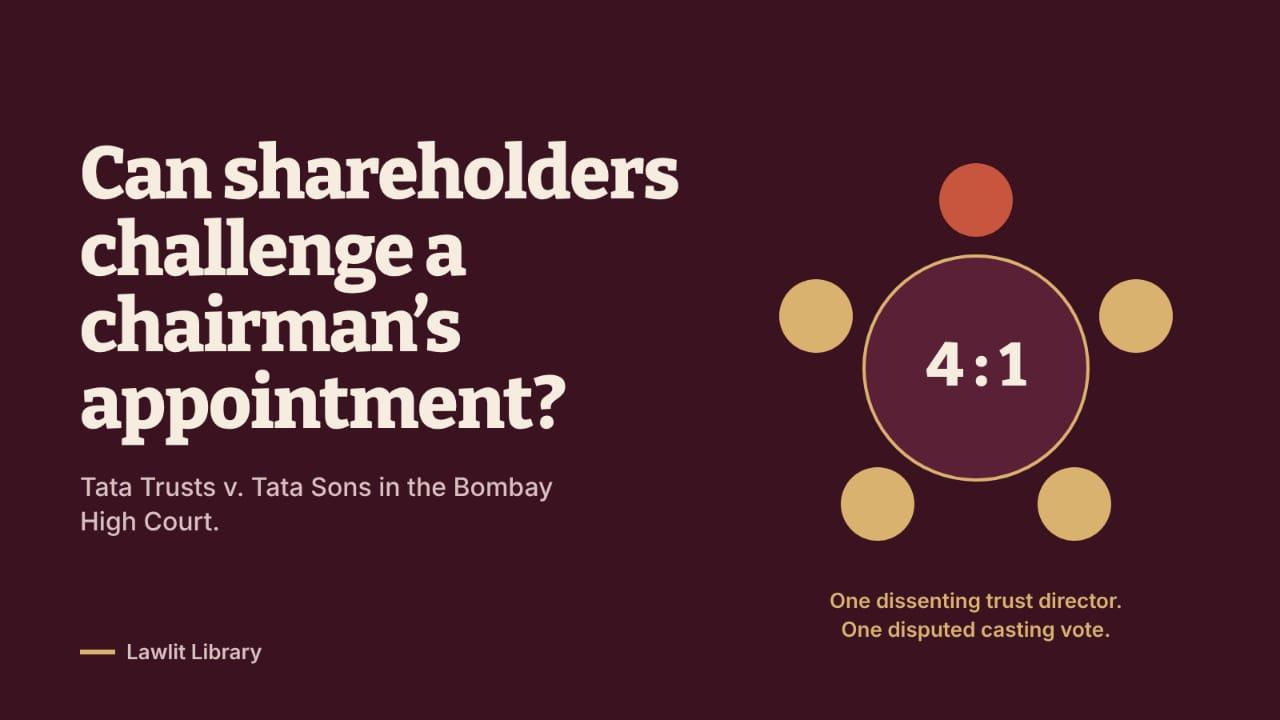
According to Bar & Bench, the resolution was treated as passed by 4:1. Venu Srinivasan, Manwani, Anita M George and Saurabh Agrawal voted in favour, and Tata Trusts chairman Noel Tata voted against. Of the two trust-nominated directors, Srinivasan supported the resolution and Noel Tata opposed it. Manwani exercised a casting vote to treat the resolution as carried.
(Press reports differ on whether this is a second or third term. Business Standard calls it a third term.)
The Challenge in the Bombay High Court
On 26 November 2026, Sir Dorabji Tata Trust (SDTT) and RD Tata Trust (RDTT) filed suits against Tata Sons, Chandrasekaran and four directors, with no relief sought against Noel Tata. They argue that the resolution is void and that it violates the Articles of Association. They seek:
A declaration that the 17 September resolution is ultra vires Article 121 and invalid.
Injunctions restraining the defendants from acting on it.
A declaration on the true meaning of Article 121, and a bar on a chair using a casting vote over the trust directors' votes.
Damages of ₹65 crore (₹50 crore by SDTT and ₹15 crore by RDTT) with 18% annual interest.
The Legal Core: Article 121 and the Casting Vote
Article 121 of the Tata Sons Articles requires, on matters decided by a majority of directors, the affirmative vote of a majority of the trust-nominated directors present. Article 104B governs the appointment of those directors.
The trusts' argument is that a casting vote exists only to break a tie across the whole board and cannot supply the affirmative trust-director approval the Articles demand. Their counsel argued before the court that once a trust nominee dissents, the required majority is missing. Counsel for Noel Tata also said a casting vote can be used only when the board is equally divided.
The other side argued that the dispute is of the trusts' own making, since they could have nominated more directors, and that the trusts can challenge the resolution separately without stalling the board. Tata Sons also relied on Section 50 of the Maharashtra Public Trusts Act, saying a trust must obtain Charity Commissioner consent before suing, and on Reserve Bank of India communications about Tata Sons' classification as an upper-layer NBFC and the question of listing.
What the Court Has Done So Far
On 27 November, Justice Abhay Ahuja refused to stay the Tata Sons board meeting scheduled for 30 November. The court said any decisions taken would be subject to the outcome of the suits. Tata Sons was given time to file a reply, and the matter will next be heard on 21 January 2027. The court has not ruled on whether the reappointment is valid.
Can Shareholders Challenge a Chairman's Appointment? The General Law
1. Articles of Association are binding. Section 10(1) of the Companies Act, 2013 makes the Articles binding on the company and its members. A shareholder can seek a declaration or injunction when a board decision breaches the Articles. The trusts rely on the Supreme Court's decision in Tata Consultancy Services v. Cyrus Investments (2021), the Cyrus Mistry case, for the proposition that enforcing such an Article is a shareholder's membership right and is not barred by Section 430, which excludes civil courts from matters reserved for the NCLT.
2. Oppression and mismanagement. Under Sections 241 and 242, members who meet the thresholds in Section 244 can approach the NCLT alleging oppression or mismanagement. The NCLT can set aside appointments or regulate the company's affairs. In the Mistry judgment, the Supreme Court set a high bar for relief.
3. Board decisions get deference. Courts generally do not second-guess business judgment. They intervene where the process breaches the Articles or the statute, which is the trusts' claim here.
Why It Matters Beyond Tata
This dispute shows why Articles of Association matter in closely held and promoter-controlled companies. Affirmative-vote rights, nominee-director rights and casting-vote clauses are negotiated protections, and their wording decides who controls the company. Founders, investors and in-house counsel should read these clauses closely. The case may also clarify how courts treat casting votes in conflict-of-interest settings.
Conclusion
Shareholders can challenge a chairman's appointment when it breaches the Articles, the Companies Act or principles against oppression. Whether the Tata Sons resolution does so now depends on the Bombay High Court's reading of Article 121. The court has refused interim relief, the 30 November board meeting is going ahead, and the next hearing is on 21 January 2027. Everything else is still allegation and argument.
Disclaimer: This article is for informational purposes only and is not legal or financial advice.
Prioritize Lawlit as your preferred source on Google
Never miss verified opportunities, deal street breakdowns, or daily legal briefs when you search.